Saturday, October 13, 2012

Health Literacy - Learn to Read Medical Prescriptions


Health Literacy - Learn to Read Medical Prescriptions


Skills Needed for Health Literacy

Patients are often faced with complex information and treatment decisions. Some of the specific tasks patients are required to carry out may include:

evaluating information for credibility and quality,
analyzing relative risks and benefits,
calculating dosages,
interpreting test results, or
locating health information.
In order to accomplish these tasks, individuals may need to be:

visually literate (able to understand graphs or other visual information),
computer literate (able to operate a computer),
information literate (able to obtain and apply relevant information), and
numerically or computationally literate (able to calculate or reason numerically).
Oral language skills are important as well. Patients need to articulate their health concerns and describe their symptoms accurately. They need to ask pertinent questions, and they need to understand spoken medical advice or treatment directions. In an age of shared responsibility between physician and patient for health care, patients need strong decision-making skills. With the development of the Internet as a source of health information, health literacy may also include the ability to search the Internet and evaluate websites.

Friday, October 12, 2012

Health Literacy - Caring for Patients with Low Health Literacy


Patients with poor reading ability have problems accessing the health care system, understanding recommended treatments, and following the instructions of providers. Because of their shame, patients with low literacy may be unwilling to disclose their problem to health care providers, and screening tests of reading ability may be necessary to identify those who need special assistance.

Thursday, October 11, 2012

Health Literacy - Making Sense of Online Health Information


Increasingly, health information is accessed via the internet, but a number of barriers prevent consumers making effective use of it. These barriers include inadequate skills to search, evaluate and use the information. It has not yet been demonstrated whether training consumers to use the internet for health information can result in positive health outcomes.  

People with low health literacy typically:
–Fail to seek preventive care
–Are less likely to follow treatment plans
–Have increased rates of hospitalization and use of emergency services
–Have difficulty understanding written and oral communication
–Stay in the hospital longer than someone with higher health literacy

There are thousands of health-related websites on the Internet. Some of the information on these websites is reliable. Some of it is not. Some of the information is current. Some of it is not. Choosing which website to trust is worth thinking about.
Some questions you may ask:

1. How do I find reliable health information online?
2. Who sponsors the website? Can you easily identify the sponsor?
3. Who wrote the information?
4. Who reviews the information? Does the website have an editorial board?
5. When was the information written?


Use your common sense and good judgment when evaluating health information online. There are websites on nearly every conceivable health topic and no rules overseeing the quality of the information. Take a deep breath and think a bit before acting on any health information you find on the web. Don't count on any one website. If possible, check with several sources to confirm the accuracy of your results. And remember to talk with your doctor.

Monday, October 8, 2012

Health Literacy - Ability to Effectively Communicate With Your Doctor


According to Healthy People 2010, an individual is considered to be "health literate" when he or she possesses the skills to understand information and services and use them to make appropriate decisions about health.
Areas commonly associated with health literacy include:
  • Patient-physician communication
  • Drug labeling Medical instructions and medical compliance
  • Health information publications and other resources
  • Informed consent
  • Responding to medical and insurance forms
  • Giving patient history
  • Public health training
  • Assessments for allied professional programs, such as social work and speech-language pathology
Alarmingly, these skills and strategies are absent in more than half of the U.S. population. This fact is more disturbing when one considers that these are the very skills and strategies that often lead to longer life, improved quality of life, reduction of both chronic disease and health disparities, as well as cost savings. 

Saturday, October 6, 2012

Health Literacy and Medical Errors

When literacy collides with health care, the issue of “health literacy” – defined as the degree to which individuals have the capacity to obtain, process, and understand basic health information and services needed to make appropriate health decisions – begins to cast a long patient safety shadow.

health care information – such as insurance forms, consent forms, and medication instructions – is often very complex and seemingly impenetrable. Even those who are most proficient at using text and numbers may be compromised in the understanding of health care information when they are challenged by sickness and feelings of vulnerability.

Health literacy also encompasses the educational, social and cultural factors that influence the expectations and preferences of the individual, and the extent to which those providing health care services can meet those expectations and preferences. Health care practitioners literally have to understand where their patients “are coming from” – the beliefs, values, and cultural mores and traditions that influence how health care information is shared and received.

We understand the importance of Health Literacy.  

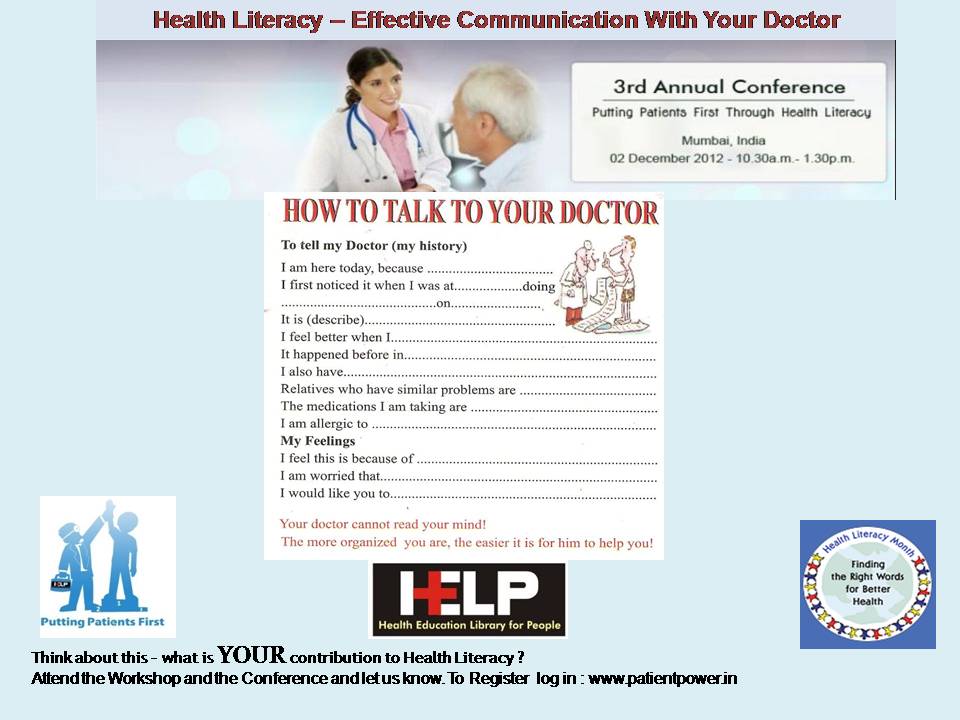
Putting Patients First Through Health Literacy - conference and free workshop scheduled to be held on Sunday, 2 Dec is a step forward in this direction.  Please visit our conference website: www.patientpower.in for complete details on how to register.

Thursday, September 27, 2012

Health Literacy – Translation of Patient Education Materials


India being a country of linguistically diverse population the importance of translating health education material cannot be undermined.  There have been many attempts in modern times to make regional language health information available to the masses.  One common thread which runs throughout the country is the national language - Hindi. We believe that access to researched, evidence-based health information is a right of every citizen of our country !

Health Education Library for People will be participating in the Health Literacy Month - October'12 to bring about awareness and emphasize on the importance of health literacy.

Putting Patients First Through Health Literacy - conference scheduled to be held on Sunday, 2 Dec is a step forward in this direction.  Please visit our conference website: www.patientpower.in for complete details on how to register.